Kailash Mansarovar Maps and Graphs
The Kailash Mansarovar Yatra is one of the most sacred pilgrimages for Hindus, Buddhists, Jains, and followers of Bon religion. Located in the remote southwestern corner of Tibet, Mount Kailash and Lake Mansarovar offer a spiritually uplifting and visually stunning journey. To help pilgrims and travelers understand the region better, we provide essential maps and elevation graphs that illustrate the geography, kora routes, altitude variations, and key landmarks.
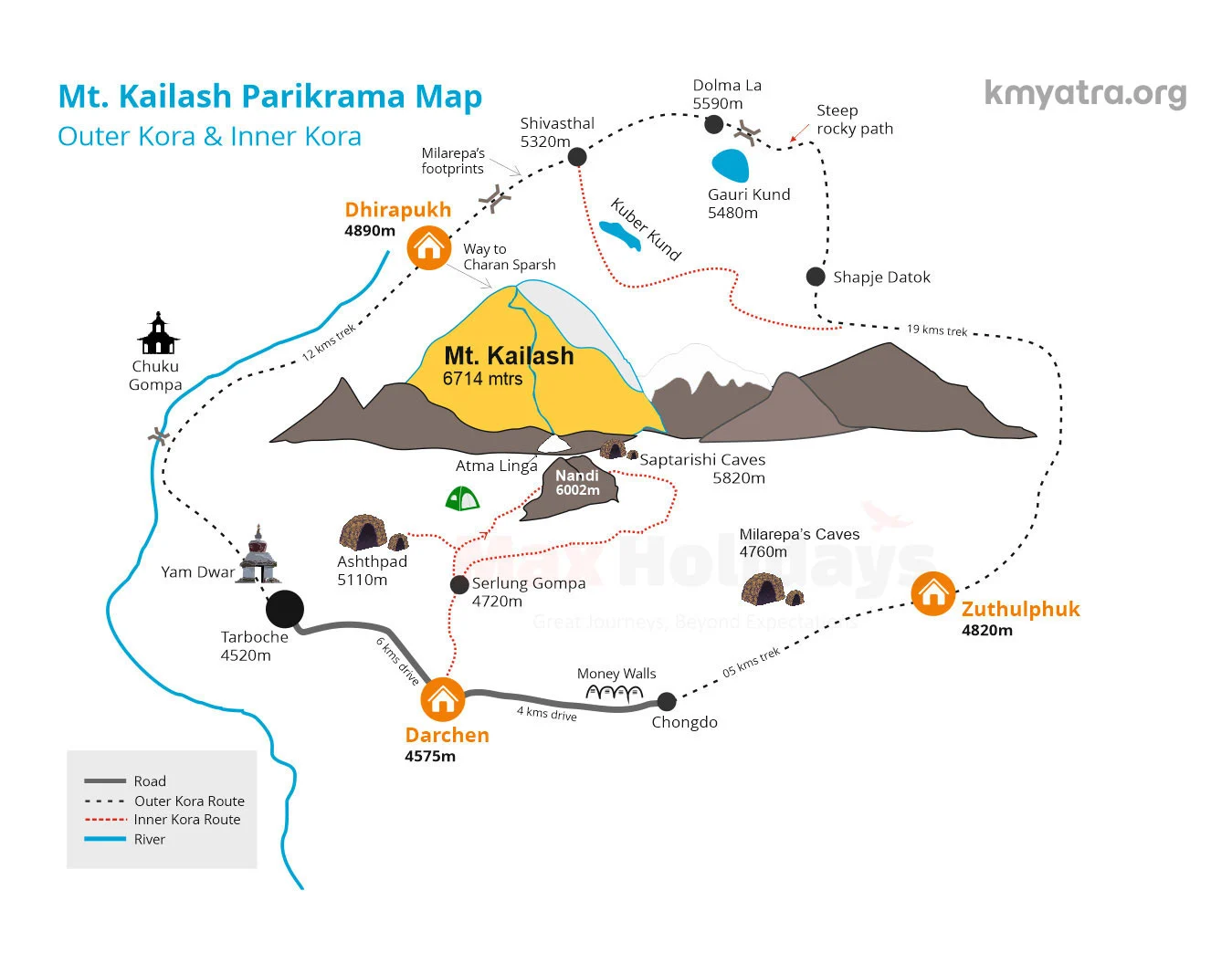
Mount Kailash Outer Kora and Inner Kora Map
The sacred Mount Kailash, located in the remote reaches of Tibet, is surrounded by two significant pilgrimage routes: the Outer Kora and the Inner Kora. These routes hold deep spiritual importance in Hinduism, Buddhism, Jainism, and Bon traditions.
The Outer Kora, approximately 52 kilometers long, is the main route taken by most pilgrims. It typically takes 2–3 days to complete and involves crossing the high-altitude Drolma La Pass (5,630 meters). This kora passes by important landmarks like the Tarboche flagpole, Dirapuk Monastery, and Zutulpuk Monastery, offering awe-inspiring views of Mount Kailash from different angles.
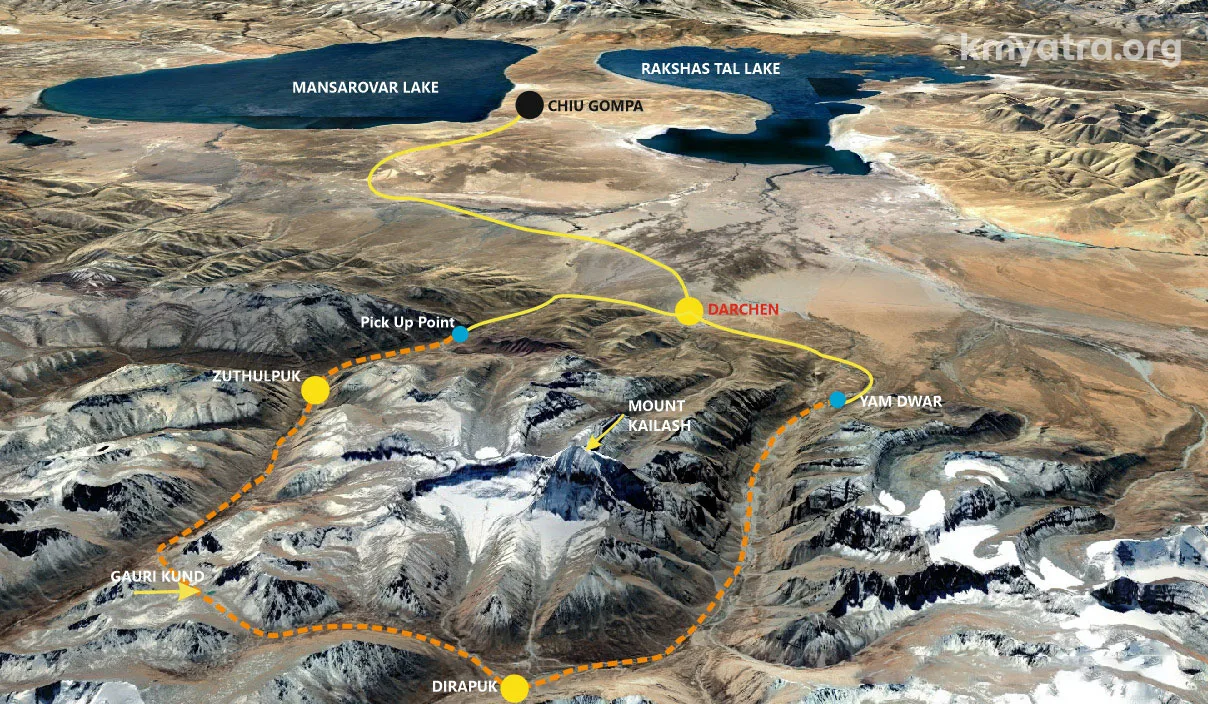
Satellite Map Lake Mansarovar to Mount Kailash Outer Kora
The satellite map of the route from Lake Mansarovar to Mount Kailash Outer Kora offers a breathtaking view of one of the world’s most sacred pilgrimage circuits. Starting from the serene Lake Mansarovar, located at an altitude of around 4,590 meters, the journey leads towards Darchen, the base point of the Mount Kailash kora.
The Outer Kora, or parikrama, encircles the majestic Mount Kailash over a rugged 52-kilometer trail, passing through notable landmarks such as the Tarboche flagpole, Dirapuk Monastery, the challenging Dolma La Pass at over 5,600 meters, and Zutulpuk Monastery. The satellite map clearly highlights the dramatic terrain of the Tibetan plateau, high-altitude passes, glacial streams, and spiritual sites, helping pilgrims and trekkers visualize and plan their sacred journey more effectively.